
David Esposito, Co-Producer of PLAY ON!, toy inventor, and CEO of Harvest Time Partners


Meet PLAY ON!’s Co-Producer: David Esposito of Harvest Time PartnersPART II: How Harvest Time Partners Plays the Long GamePLAY ON! Will the Fun Survive? is an upcoming documentary that covers the real struggles and triumphs of new specialty toy inventors at Toy Fair 2008 – and asks "Where are they now?" When David Esposito, founder of Harvest Time Partners and co-producer of the PLAY ON! toy documentary, first brought his Abundant Harvest games to Toy Fair, he had high hopes. Like our inventors and many other independent game and toy creators, he envisioned interest from major retailers. “I was really hopeful that people would see value in the game and want to take it on,” David said. But the reality was more sobering. “The first couple times at Toy Fair didn’t lead to much,” he remembered. “A lot of handshaking, nice booth traffic, but nothing really followed up.” It wasn’t until his third year at the show that he secured a modest distribution opportunity from the educational chain Mardel and later from faith-based New Day Distributors. Like many of our PLAY ON! inventors, he found that smaller toy stores and specialty retailers were his best fit. Why Smaller Can Be BetterIn hindsight, he sees this slower path has a hidden advantage. Large retail deals, he learned, often come with significant financial risk. “They don’t buy your game outright,” he cautioned. “They demand big runs of 25,000 or more. You’ve got to fully fund them yourself. If they don’t sell the games, they shove them back to you at cost.” Those dreamed-of deals bankrupt a lot of young inventors. Instead, David and his wife Tracy built their business gradually—through Amazon, smaller distributors, and direct fulfillment. Even today, he remains hands-on. “There’s something fulfilling about taping and sticking labels and shipping off your game,” he said. “I feel a sense of gratification that the product's moving and I’m physically doing it that way.” He also gets a daily sales total from Amazon, and an email telling him when he’s sold four or five games. This steady, grounded approach mirrors his broader philosophy: Impact doesn’t have to be massive to be meaningful. “We’re changing lives one by one,” he stated. Changing the ConversationAt the core of everything David creates is a belief that communication is the foundation of healthy relationships. In today’s world, he sees that foundation under strain. “It’s a timeless, age-old problem,” he admitted. “But the acceleration of social media has put gas on that already deficient area.” He points to a combination of factors: digital communication, algorithm-driven echo chambers, and a decline in face-to-face interaction. The result, he believes, is increased loneliness and, at times, harsher discourse. “There’s a dimension of emotional connection you can’t get as firmly online, as compared to being physically face-to-face,” he said. That’s why his mission is more important than ever. Through Harvest Time Partners, Esposito develops tools not just for families, but for professionals. His books, courses, and coaching help leaders communicate across generations and build stronger teams. “How do you make individuals feel seen, heard, valued… and how do you do that generationally?” he asks. “How does someone in Gen Z effectively communicate with an ‘old’ guy like me? I grew up in a very traditional office environment. Younger people who took their first job never actually shook hands with anybody on their team.” The Power of Face-to-Face PlayHe noted that you could use Gemini or any AI tool to build a business plan at the tap of a keyboard. “But how do you build passion? How do you make individuals see how they matter to their team and how they matter to the company’s goals? Those are heavy-duty communication skills,” he said. Even though he’s been in leadership positions for most of his adult life, David admits that he still needs to learn and grow. His humility is part of what sustains his long-term commitment—not just to the business, but to the purpose behind it. Equally critical is the support of his wife, Tracy. Their partnership has been both a stabilizing force and a source of honest tension. “You’ve got to be aligned around this… financially, we’re putting a lot of bets on what we’re doing,” he admitted. There were difficult conversations—moments where the risks felt too high or the path uncertain. But ultimately, they shared a belief in the mission. “We both saw a real need and wanted to jump in and try it.” Now, as an empty nester with more time to reflect and create, David continues to expand his work—developing new products, writing, and sharing insights through videos and speaking engagements. He’s realistic about the pace of growth. He’s clear-eyed about the challenges. But he’s still driven by the same core idea that started it all: “There are some real needs out there… and maybe there’s a product or two that could help.” PLAY ON! Will the Fun Survive? is a documentary film that highlights the untold stories of lone inventors who launched their new games and toys at Toy Fair 2008. Support the film with a tax-deductible donation and help the next generation of independent inventors. |
David Esposito, Co-Producer of PLAY ON!, toy inventor, and CEO of Harvest Time Partners

ABUNDANT HARVEST for Kids
|
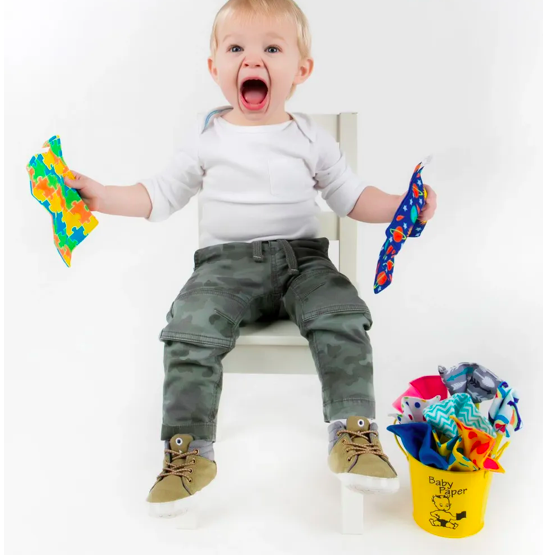
Survival of the SmallestWhy Specialty Toymakers Should Band TogetherPLAY ON! Will the Fun Survive? is an upcoming documentary that covers the real struggles and triumphs of new specialty toy inventors at Toy Fair 2008 – and asks "Where are they now?" If you ask Sari Wiaz, founder of the crinkly, soothing phenomenon known as Baby Paper®, why she’s still in business after years of supply chain chaos and aggressive tariffs, she won’t give you a corporate spiel. She’ll give you the truth. “The only reason I’m still sticking in is because I’m stubborn, naive, and stupid,” Wiaz jokes. “I could have worked a minimum wage job and been further ahead.” It’s a laugh-to-keep-from-crying sentiment shared by many small manufacturers right now. For the boutique toy industry, the last few years haven't just been a hurdle; they’ve been a wall.
"Every day I’m hearing more and more of my retail partners who are giving up," Wiaz says. "They don’t want to be in specialty anymore. Rents are too much. They're tired of fighting Amazon. It's very hard right now for a small brand to make it: Even the ones who have great brand recognition. People put up their houses for collateral." Wiaz recalls being at Toy Fair when the tariffs were first announced.“The first day, it was 10% and everyone went ‘UGH.’ Then, the next day, they said 20%. It sucked the oxygen out of the room. Small brands work on really small margins. We can’t afford a hit like that.” The "David vs. Goliath" of InventoryThe logic of "just make it in America" hits a snag when you look at the ledger. Wiaz looked into domestic sourcing long before the trade wars began. The reality? Raw goods still come from China, domestic production is significantly more expensive, and labor shortages make it nearly impossible to scale. This creates a vicious cycle for cash flow. Unlike the "Big Guys" who stock up with six months of inventory to ride out storms, small brands buy cautiously to protect capital.
“My retailers have fatigue,” Wiaz explains. “They don’t want to hear about tariffs or emails about stock. They want something positive. But how do you create that positive feeling when you’re watching your hard work go out the window?” Finding Strength in the "Small"So, how do the small players survive when rents are high, Amazon is predatory, and trade shows seem to prioritize the giants? They stop trying to be big and start trying to be connected. Wiaz runs the Small Manufacturers Networking Group, a quarterly gathering of minds that has become a lifeline for independent creators. They aren't just crying on each other's shoulders; they are strategizing. To combat the high costs of shows like Toy Fair -- which doesn't have much space for or interest in small brands -- Wiaz and her small manufacturing group band together. Last year, they were the main occupants of the "Petite Pavillion," which Toy Fair had constructed at Wiaz's insistence. Still, they had poor visibility. Wiaz isn't heading to Toy Fair this year.
They also share resources: From media contacts to sourcing tips, the group operates on a "rising tide lifts all boats" mentality.
The Consumer DisconnectPerhaps the most telling insight Wiaz offers is the difference between the industry and the customer. At a recent ChiTAG event open to the public, Wiaz shared space with ChattySnaps®. While retailers often obsess over packaging footprints and category fit, the actual consumers—parents and kids—obsessed over the feel. “Every kid and adult walking by my table stopped to touch [Baby Paper],” Wiaz says. “The consumer looks different than the retailer.” For Wiaz, and the brands she networks with, the goal now isn't a massive exit strategy or a buyout—options that have dried up in the current climate. It’s about keeping the legacy alive, maintaining the passion, and helping the manufacturer next to you stay afloat. “I don’t regret one moment in this industry because of the people I’ve met,” Wiaz says. “It’s interesting, creative, but hard work. I also believe in my product.” To join Sari’s networking group, email her at sari@wizechoicecreations.com. The pressures Sari faced are the same challenges threatening specialty toy creators everywhere. PLAY ON! Will the Fun Survive? is a documentary film that highlights the untold stories of lone inventors who launched their new games and toys at Toy Fair 2008. Support the film with a tax-deductible donation and help the next generation of independent inventors. -- |


|
David Esposito of Harvest Time Partners signed on as a co-producer of PLAY ON! partly because the story of our intrepid first-time inventors betting all they had at Toy Fair 2008 resonated with his own experience. Like many of them, he developed his first games – Abundant Harvest for Kids and Abundant Harvest for Teens and Adults – because he’d identified a social need he wanted to address.
His journey into the toy industry didn’t begin with a flash of inspiration. It began with a slow realization – based on his failures and frustrations as a parent and partner – that families struggle to communicate.
He remembers the busy day when he came home from work and had to get ready for his MBA class. As he frantically packed up his books, his 2-year-old daughter happily told him about all the wonderful things that had happened to her that day.
Then he noticed she’d stopped talking.
“I turned and saw that she was crying because I wasn’t paying attention,” he recalled. That moment was part of what he describes as “a series of experiences where I realized parents and kids just don’t fully sync up in terms of effective communication.”
While another dad might just chalk up that experience to the challenges of parenthood, thanks to his family background, David saw an opportunity.
“My mother came over from Glasgow, Scotland, and my father’s family were Italian immigrants who started a fruit and vegetable market – Esposito’s on State Street in Hackensack, New Jersey,” David said. “I grew up understanding the impact that a local family business has on a community.”
Although he was working for a pharmaceutical company as a sales rep, the challenges of raising four kids and a foster child with his wife Tracy stirred up his entrepreneurial blood. He also realized that he could teach families the values he’d learned from serving in the military.
“Several relatives had served in the military during World War II, which had inspired me to go to West Point,” he said. “I then spent years on active duty with the 101st Airborne Division, which gave me a sense of the importance of serving a cause bigger than yourself, the responsibility of leaders, and the value of principle-based decision making.”
Once he realized that both his and other families never learned to “put real issues on the table,” he and Tracy began to develop Abundant Harvest.
“The goal was to create a game that allowed parents and kids to have intentional conversations instead of reacting to problems in the heat of the moment,” he explained. “They’re designed to help people be a little bit more reflective. They’re guided by principles like compassion, honesty, and teamwork.”
Development took roughly five years, from early concept to prototype to final production. Like some of the inventors in PLAY ON!, David and his wife made a bold — and risky — decision: they took out a second mortgage on their home to fund the game.
“At the time, it seemed not as financially risky,” he said, referring to the pre-2008 housing market. “Looking back, it was probably a very foolish financial move.”
Still, he doesn’t regret it.
“I felt like, man, there’s something there. There’s a real need.”
That belief carried the couple through a difficult launch. The game debuted in 2007—just as the financial crisis began to unfold. By 2009, markets had collapsed. In addition to taking that second mortgage, David had also left a stable corporate job to pursue early-stage biotech ventures.
It was a precarious moment.
The business grew slowly, without major retail deals or breakout success. However, David found validation in smaller, more personal ways.
“Even now, I get notes from parents reaching out to say something like, ‘our son opened up on things we didn’t know he was going through.’ That’s really gratifying."
For David and Tracy, those moments matter more than scale. The goal was never just to sell a game. It was to create a tool that could change how families talk to each other — one conversation at a time.
NEXT: How Harvest Time Partners Plays the Long Game